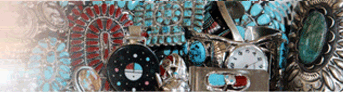
| We are proud to offer high quality handmade and handcrafted, authentic Native American jewelry. All of our Native American Indian Pieces are hand picked to ensure the best quality. All of our items listed as Navajo, Zuni, or Native American are guaranteed to be authentic Native American jewelry. We also feature Southwest Style jewelry, as well as other high quality Sterling Silver and Gold jewelry at the lowest prices possible, these pieces are not made or listed as Native American. We are happy to offer beautiful Baltic Amber pieces that are made in Eastern Europe. All of our Baltic Amber is genuine and comes from the Baltic Sea. Many of our chains come from Italy.
Most of our jewelry features beautiful stones such as turquoise, coral, onyx, lapis, gaspeite, mother of pearl, amber, and many more.
Contact us at 1-505-797-8760
100% satisfaction guarantee Most of our items are handmade or handcrafted and a different stone is used each time so sometimes the shade, shape, or matrix can be slightly different. The design and type of stone on the piece will remain the same. We accept returns within 30 days from the day you receive the item with a 15% restocking fee as long as the item is in re-sellable condition. Damaged items can be exchange or repaired within 30 days. Many times we offer a free gift with your purchase but it needs to be returned if your order is being returned since the gift is with a minimum purchase. We will gladly waive the restocking fee if the return is being exchanged for something of equal or greater value. We reserve the right to cancel any order for any reason.
Turquoise
This glowing stone is the favorite of people who
purchase Navajo and Zuni jewelry. It is also among the
most important stones for Native Americans of the
Southwest.
Ranging in color from a deep blue to green-blue to a
striking sky blue, the semi-precious stone's color
determines its value. Formed by waters percolating through
rocky deposits, turquoise is frequently discovered near
copper mines and is usually mined in desert and arid
regions.
The stones may shine with uniform color or with matrix
lines that add contrast and enhance their beauty. "Spiderweb"
patterns are especially coveted.
A December birth stone, turquoise is said to be the stone
of love that will produce happy thoughts for all who wear
it. Native American belief associates turquoise -- a gift
from the gods -- with horses, discovering desert water and
attracting wild game.
Turquoise has been used throughout the world as ornament
and trade items for thousands of years. Turquoise jewelry
dating back 25,000 years has been found in the layered
cliffs of Chaco Canyon, New Mexico. Today, Native
Americans and non-natives continue to trade this
fascinating stone.
Silver
Native Americans became master silversmiths in the
1800s after being introduced to the skill by Spanish
traders.
A early description of a Navajo warrior tells of an outfit
lavishly trimmed with silver buttons. Photographs made
during the 1860s and 1870s also show the Navajo tradition
of silver buttons, originally made from Mexico silver
pesos (coins) and later from American silver dollars.
A stunning bed of silver usually surrounds a turquoise
stone. At the Navajo Shopping Center, you'll find
exquisite Navajo and Zuni jewelry. It is frequently made
by silversmiths from families who have perfected various
silver techniques for generations. Each piece is steeped
in tradition, created with care.
Navajo Jewelry
Navajo jewelry making and silversmithing techniques
include sandcasting and tooled sheet, wire and ball work.
Navajo concho belts or squash blossom necklaces, inspired
by the Mexican pomegranate, may feature elaborate silver
work. In contrast, the turquoise is typically a simple but
large stone, or several medium stones.
Sandcasting
Sandcasting, more appropriately called stonecasting or
tufacasting, is one of the oldest and most beautiful ways
in which Navajos create jewelry. Dating from the 19th
century, silver is heated and poured into a stone mold.
Decorative stones are added. Additional molten silver is
poured to finish the piece, which is then filed, polished
and sanded.
Zuni Jewelry
Jewelry made by Zuni Indians tends to emphasize stones
set in elaborate inlaid designs. Frequently, turquoise is
surrounded by a mosaic of other bright stones -- coral,
mother-of-pearl, lapis, malachite, jet.
Because their pueblo is near railroad lines, the Zunis
were among the first to acquire electricity and the
stone-cutting materials that make their jewelry so
stunning -- and coveted among many other Native American
tribes.
Native Indian Made is UpFront
|